From Exclusion to Equality: The Evolution of Disability Rights in America
For much of American history, people with disabilities were not simply overlooked—they were systematically excluded from education, employment, transportation, housing, and everyday community life. The rights many Americans now take for granted were earned through decades of advocacy, protest, legislation, and the courage of people with disabilities who refused to accept discrimination as a way of life.
While tremendous progress has been made since the 1950s, the journey toward full equality is far from over.
Life with a Disability in the 1950s: A Hidden Population
The 1950s were a difficult time for millions of Americans with disabilities. Society often viewed disability through a medical or charitable lens rather than recognizing it as a civil rights issue. People were frequently seen as objects of pity or charity instead of individuals with talents, dreams, and the right to participate fully in society.
Children with disabilities were often denied access to public education. Many attended segregated institutions, while others received no formal education at all. Families were commonly advised to place children with significant disabilities in state institutions rather than raise them at home.
Employment opportunities were extremely limited. Employers openly refused to hire qualified individuals simply because they had a disability. There were virtually no legal protections against discrimination.
Physical accessibility was almost nonexistent. Buildings lacked ramps, elevators, accessible restrooms, curb cuts, and automatic doors. Public transportation was largely inaccessible, making independent living nearly impossible for many.
Social attitudes created some of the greatest barriers. People with disabilities were often invisible in media, politics, and public life. The assumption was that they should adapt to society rather than society adapting to include them.
The 1960s: The Seeds of Change
As the Civil Rights Movement gained momentum, people with disabilities began organizing and demanding equal treatment. Disability advocates recognized that discrimination—not disability itself—was often the greatest obstacle.
Parent advocacy groups pushed for educational opportunities for children with disabilities.
Independent living philosophies began emerging, emphasizing self-determination rather than institutional care.
Disabled veterans returning from war also highlighted the need for accessibility and rehabilitation.
Although few federal laws existed during this decade, public awareness slowly began to shift.
The 1970s: Disability Rights Become Civil Rights
The 1970s marked one of the most important turning points in disability history.
Rehabilitation Act of 1973
Section 504 of the Rehabilitation Act became the first federal civil rights law protecting people with disabilities from discrimination by organizations receiving federal funding.
For the first time, disability discrimination was recognized as a violation of civil rights.
The law prohibited discrimination in:
Education
Government programs
Federal agencies
Federally funded organizations
However, implementation was slow. Disability activists organized historic protests, including the famous 504 Sit-In of 1977, one of the longest nonviolent occupations of a federal building in U.S. history. Their persistence led to the signing of regulations that gave Section 504 real meaning.
Education for All Handicapped Children Act (1975)
This landmark law guaranteed that children with disabilities had the right to a free and appropriate public education.
It transformed education by requiring schools to provide services rather than excluding students because of their disabilities. Today, this law is known as the Individuals with Disabilities Education Act (IDEA).
The 1980s: Building Momentum
Throughout the 1980s, disability rights advocates continued pressing for broader protections.
Independent Living Centers expanded across the country.
Accessible public transportation became a growing priority.
Businesses slowly began recognizing accessibility needs.
Advocates increasingly argued that disability discrimination belonged alongside race and gender discrimination as a civil rights issue.
The disability rights movement grew stronger, more organized, and more visible than ever before.
1990: The Americans with Disabilities Act Changes America
On July 26, 1990, President George H. W. Bush signed the Americans with Disabilities Act (ADA) into law.
The ADA became one of the most significant civil rights laws in American history.
The law prohibits discrimination against qualified individuals with disabilities in nearly every aspect of public life.
The ADA protects individuals in areas including:
Employment
State and local government services
Public transportation
Public accommodations
Telecommunications
Public facilities
The ADA also introduced the concept of reasonable accommodations, requiring employers and organizations to remove unnecessary barriers whenever doing so would not create undue hardship.
Suddenly, accessibility became a legal requirement rather than an optional act of goodwill.
The ADA's Lasting Impact
Since 1990, the ADA has fundamentally changed American society.
Communities now routinely include:
Wheelchair ramps
Accessible parking
Curb cuts
Elevators
Closed captioning
Accessible websites
Service animal protections
Sign language interpreters
Equal employment protections
Millions of Americans have gained access to education, careers, transportation, healthcare, and community life because of the ADA.
The law also shifted public attitudes by reinforcing that disability rights are human rights.
The ADA Amendments Act of 2008
Court decisions had narrowed the definition of disability, making it harder for individuals to qualify for ADA protections.
Congress responded by passing the ADA Amendments Act (ADAAA), restoring broader protections and reaffirming that the focus should be on preventing discrimination—not debating whether someone has a disability.
The amendments strengthened the ADA and expanded protections for millions of Americans.
Where We Are Today
America has made enormous progress over the past seventy years.
People with disabilities now serve as:
Business owners
CEOs
Lawyers
Doctors
Teachers
Athletes
Authors
Public officials
Entrepreneurs
College professors
Media personalities
Assistive technology continues opening doors through screen readers, speech recognition, AI tools, mobility devices, and smart-home technology.
Remote work has also created new employment opportunities by allowing many individuals to contribute without unnecessary physical barriers.
Representation in television, film, advertising, and leadership positions continues to improve.
Yet despite these advances, significant disparities remain.
How Far We Still Have to Go
Many barriers continue to prevent people with disabilities from achieving full equality.
Employment
The unemployment and underemployment rates for people with disabilities remain significantly higher than those of people without disabilities. Many qualified candidates still encounter bias during hiring and advancement.
Accessibility
Although new buildings generally comply with accessibility standards, older facilities, housing, and transportation systems continue to present challenges. Digital accessibility also remains inconsistent, preventing equal access to websites, mobile apps, and online services.
Healthcare
People with disabilities often face inaccessible medical equipment, communication barriers, transportation challenges, and disparities in preventive care and treatment.
Education
While schools are more inclusive than in the past, many students still struggle to receive appropriate accommodations, accessible instructional materials, and equal opportunities to participate in extracurricular activities.
Economic Security
Individuals with disabilities are more likely to experience poverty and financial instability. Public benefit programs often contain complex rules that can discourage employment, entrepreneurship, and savings.
Changing Attitudes
Perhaps the greatest challenge is overcoming stereotypes. Too often, disability is still viewed through the lens of limitation rather than potential. True inclusion requires recognizing the abilities, contributions, and leadership of people with disabilities.
The Future of Disability Rights
The next chapter of disability rights will extend beyond physical accessibility.
It includes digital inclusion, accessible artificial intelligence, equitable healthcare, affordable housing, entrepreneurship, leadership opportunities, and universal design that benefits everyone.
Technology offers tremendous promise, but only if accessibility is built into innovation from the beginning.
The disability community must continue to have a seat at the table whenever policies, technologies, and public spaces are designed.
As the disability rights movement reminds us:
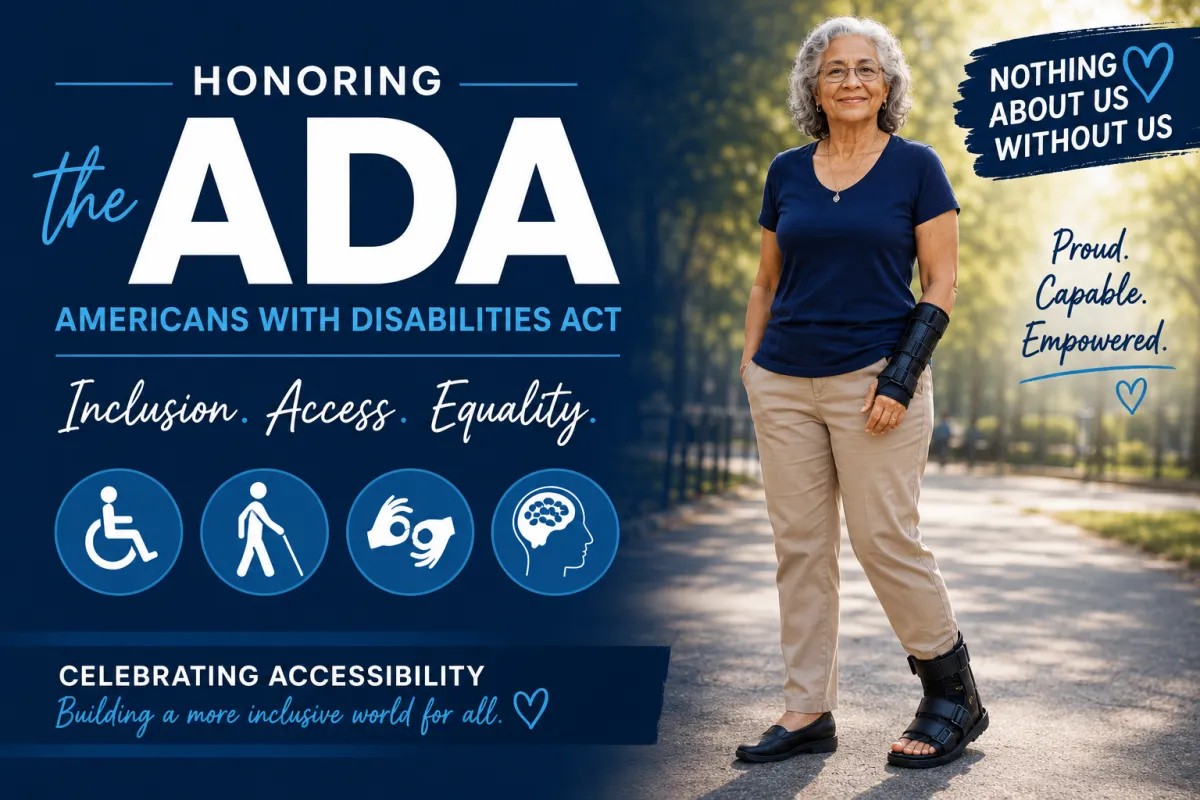
"Nothing About Us Without Us."
Final Thoughts
The journey from the exclusion of the 1950s to the protections of today represents one of America's most significant civil rights achievements. Every ramp, captioned video, accessible website, interpreter, workplace accommodation, and inclusive classroom exists because generations of advocates refused to accept inequality.
The Americans with Disabilities Act transformed the nation, but laws alone cannot create true inclusion. That responsibility belongs to all of us.
As we honor the progress made over the past several decades, we must also commit ourselves to building a future where disability is never a barrier to opportunity, independence, dignity, or success.
The work continues—and each generation has the opportunity to move the disability rights movement one step closer to full equality.
The progress we've made since the 1950s proves that change is possible. Every law passed, every barrier removed, and every opportunity created has been the result of people who believed that equality was worth fighting for. The disability rights movement has never been about asking for special treatment—it has always been about ensuring equal opportunity, equal access, and equal dignity.
At DisabilityRightsAdvocate.com, our mission is to educate, empower, and advocate for individuals with disabilities while promoting greater awareness, inclusion, and economic independence. We believe that every person deserves the opportunity to live, work, learn, and thrive without unnecessary barriers standing in their way.
Whether you're a person with a disability, a family member, caregiver, educator, employer, policymaker, or simply someone who believes in equality, you can make a difference.
You can support the movement by:
Learning about disability rights and sharing accurate information.
Advocating for accessible workplaces, schools, businesses, and communities.
Supporting organizations that advance disability rights and inclusion.
Encouraging employers to hire qualified individuals with disabilities.
Promoting accessible technology, websites, and digital content.
Speaking up when you see discrimination or barriers that prevent equal participation.
Amplifying the voices and leadership of people with disabilities.
Real progress happens when we work together. Every conversation changes perceptions. Every act of advocacy opens another door. Every accessible building, website, classroom, and workplace creates opportunities that benefit not only people with disabilities but society as a whole.
As we celebrate the legacy of the Americans with Disabilities Act, let us remember that the ADA is not the finish line—it is the foundation upon which we continue building a more inclusive America.
Together, we can create communities where accessibility is expected, inclusion is embraced, and every individual is valued for their abilities, talents, and contributions.
Our Vision
We envision a world where disability is never viewed as a limitation but as one aspect of the rich diversity that strengthens our communities. A world where every child receives an inclusive education, every adult has the opportunity for meaningful employment, every entrepreneur has access to resources to build a successful business, and every individual can live with dignity, independence, and purpose.
Our Commitment
At DisabilityRightsAdvocate.com, we remain committed to:
Promoting disability rights and equal opportunity.
Advancing accessibility in every aspect of society.
Supporting entrepreneurship and economic empowerment.
Providing educational resources and advocacy tools.
Celebrating the achievements and contributions of people with disabilities.
Inspiring the next generation of disability leaders and advocates.
The story of disability rights is still being written.
Let's write the next chapter together.
Because accessibility is more than compliance. Inclusion is more than accommodation. Equality is more than a law—it is a promise we must continue to keep.

Disability Rights Advocate
3 Keswick A
Deerfield Beach, FL 33442
Private Policy
Terms & Conditions